
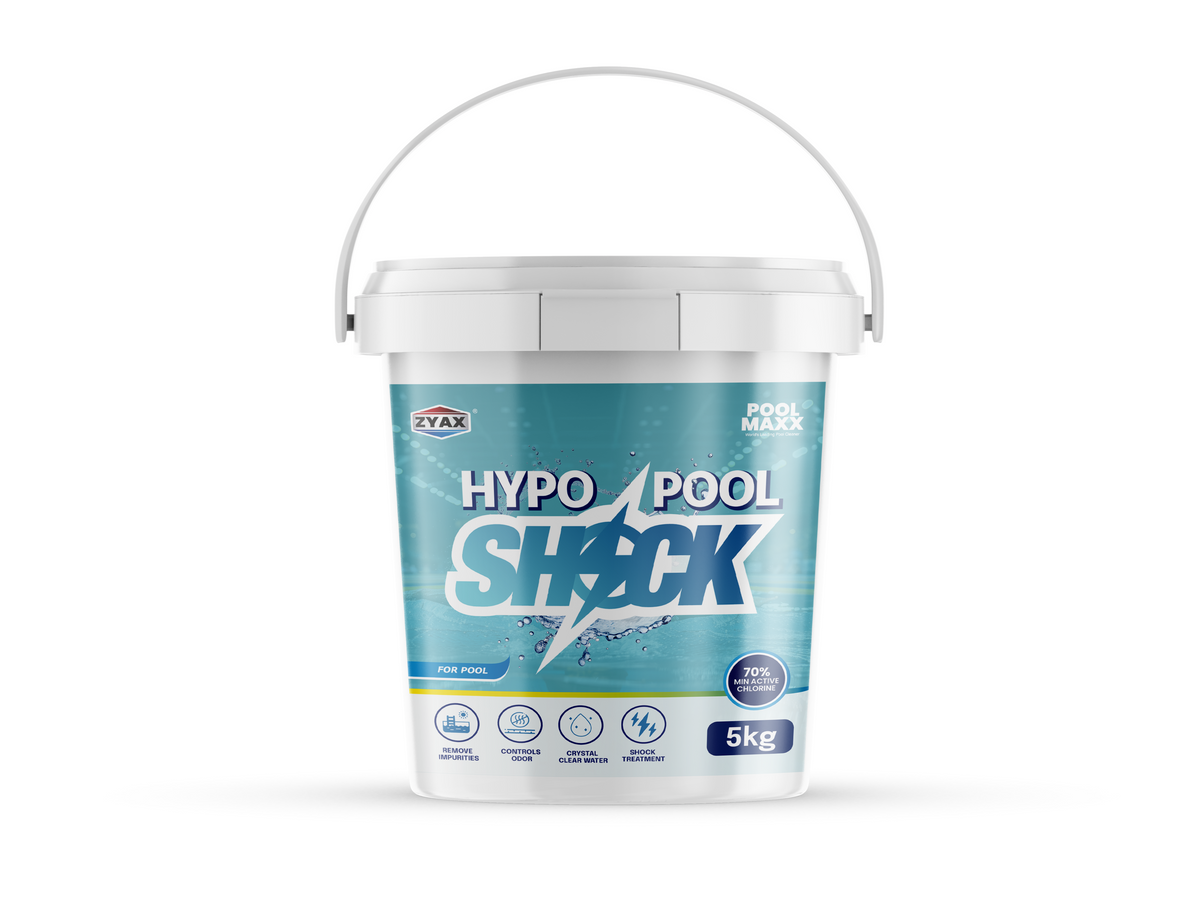
Calcium hypochlorite is a solid form of chlorine, sold as granules or tablets, and the most common way to shock a swimming pool in India. If your pool is cloudy, turning green, or smells strongly of chlorine, a calcium hypochlorite shock is usually the fix.
Quick answer: with Hypo Pool Shock, 150 g per 1 lakh litres raises chlorine by 1 ppm, and a full shock is 750 g to 1.2 kg per 1 lakh litres (from the product label). Dissolve it in a bucket of water first and pour it around the pool with the pump running.
Shop calcium hypochlorite: Hypo Pool Shock, high-strength calcium hypochlorite granules in 1 kg to 50 kg packs.
View productWhat is calcium hypochlorite?
Calcium hypochlorite, formula Ca(OCl)2, is a chlorine compound that dissolves in water and releases chlorine to kill bacteria and algae. In pools it is used mainly as a shock: a large, one-off dose that burns off contamination quickly.
It is not the same as household bleaching powder. Bleaching powder is a weaker, related product; pool-grade calcium hypochlorite is more concentrated and made for water treatment.
When to use it
- Cloudy or green water
- After heavy rain
- After a pool party or heavy swimmer load
- A strong chlorine smell or red eyes, which mean chloramines have built up
- As a regular shock: once a week in heavy use or after rain, and at least once a month otherwise
How much to add
All doses are from the Hypo Pool Shock label. For other sizes, use the pool dose calculator.
| Pool size | To raise chlorine by 1 ppm | Shock dose |
|---|---|---|
| 20,000 litres | 30 g | 150 to 240 g |
| 50,000 litres | 75 g | 375 to 600 g |
| 1,00,000 litres | 150 g | 750 g to 1.2 kg |
How to shock a pool with calcium hypochlorite
- Test the water with 5-in-1 test strips and bring pH to 7.2 to 7.6 with pH Down or pH Up. Chlorine works poorly when pH is high.
- Weigh the dose and dissolve it in a bucket of pool water. Always add the granules to water, never water to the granules.
- Pour the solution slowly around the edge of the pool with the pump running.
- Shock in the evening so the sun does not burn off the chlorine.
- Run the filter, then retest. Swim only when free chlorine is back between 1 and 3 ppm.
For the full routine, see how to shock a swimming pool and balance the pH.
Calcium hypochlorite or TCCA chlorine tablets?
| Calcium hypochlorite (Hypo Pool Shock) | TCCA 90 (Chloro Maxx tablets and granules) | |
|---|---|---|
| Best for | Shocking cloudy or green water | Everyday chlorination |
| Contains stabiliser | No | Yes (cyanuric acid) |
| How it dissolves | Pre-dissolve in a bucket | Tablets slowly in a skimmer or floater; granules quickly |
Many pools use both: Chloro Maxx 90 tablets for daily chlorine, and Hypo Pool Shock when the water needs a reset. Read more about the stabiliser in cyanuric acid in pools.
Safety and storage
- Never mix calcium hypochlorite with TCCA tablets or granules, acids or any other chemical. Add each product to the pool separately.
- Store in a cool, dry, well-ventilated place away from sunlight, heat and moisture, tightly sealed and out of reach of children.
- Wear gloves and avoid breathing the dust when measuring.
More pool care guides
Frequently asked questions
What is calcium hypochlorite used for in a pool?
It is used to shock the pool: to clear cloudy or green water, remove the chlorine smell caused by chloramines, and disinfect after rain or heavy use.
How much calcium hypochlorite should I add?
With Hypo Pool Shock, 150 g per 1 lakh litres raises chlorine by 1 ppm. A shock dose is 750 g to 1.2 kg per 1 lakh litres, from the product label.
Is calcium hypochlorite the same as bleaching powder?
No. Bleaching powder is a weaker, related product. Pool-grade calcium hypochlorite is more concentrated and made for pool shocking.
When can I swim after adding calcium hypochlorite?
Follow the waiting time on the label and retest first. Swim only when free chlorine is back between 1 and 3 ppm.
Can I mix calcium hypochlorite with chlorine tablets?
No. Never mix calcium hypochlorite with TCCA chlorine tablets or granules, or with any other chemical. Add each product to the pool separately.
