
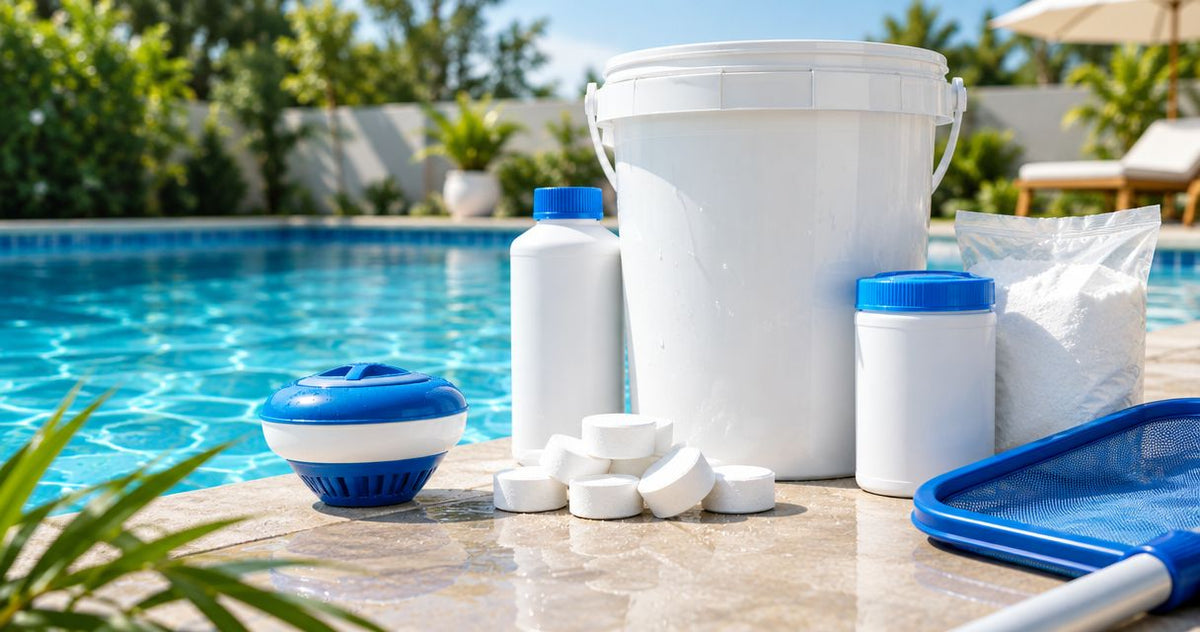
Best for routine chlorination: Chloro Maxx TCCA 90 Chlorine Tablets. Best for rapid oxidation: Hypo Pool Shock. Best for fine suspended particles: a pool clarifier. This 2026 guide compares seven pool cleaning chemicals by treatment role, including two named products from Zyax.
- Chloro Maxx TCCA 90 Chlorine Tablets suit routine chlorination when stabiliser levels are monitored.
- Hypo Pool Shock suits rapid oxidation; calcium hardness affects its suitability.
- Choose pool cleaning chemicals by water-test results, not appearance alone.
- Pool clarifiers support filtration; flocculants require a way to remove settled debris.
Why this matters
Pool cleaning chemicals do different jobs. Chlorine disinfects, balancing chemicals correct water chemistry, and clarification products help remove suspended particles. None replaces brushing, circulation or a working filter.
Zyax pool cleaning chemicals suit buyers seeking named chlorine treatments with clearly identified active ingredients. Chloro Maxx TCCA 90 Chlorine Tablets use TCCA; Hypo Pool Shock uses calcium hypochlorite. Their effects on stabiliser and calcium levels make them different choices, not interchangeable containers of chlorine.
What makes the best pool cleaning chemicals in 2026?
Choose against these criteria before selecting a product:
- Treatment fit: Match the chemical to a measured imbalance or identified cleaning problem.
- Active ingredient: Know whether chlorine treatment adds stabiliser or calcium.
- Water chemistry: Check pH, free chlorine, total alkalinity, calcium hardness and cyanuric acid as relevant.
- Equipment fit: Confirm feeder, filter and vacuum compatibility from the label and equipment instructions.
- Handling requirements: Read dosing, protective-equipment, storage and re-entry instructions before opening the container.
Pool cleaning chemicals at a glance
These seven picks combine named chlorine products with chemical categories for specific corrective jobs. The category entries are not claims about additional products in the Zyax range.
| Chemical or product | Best for | Standout function | Key limitation |
|---|---|---|---|
| Chloro Maxx TCCA 90 Chlorine Tablets | Routine stabilised chlorination | Supplies chlorine with cyanuric acid | Repeated use increases stabiliser |
| Hypo Pool Shock | Rapid oxidation | Calcium hypochlorite granules | Adds calcium to the water |
| Pool pH reducer | Measured high pH | Lowers pH | Also affects total alkalinity |
| Pool pH increaser | Measured low pH | Raises pH | Excess dosing overshoots the target |
| Sodium bicarbonate alkalinity increaser | Measured low total alkalinity | Improves buffering | Not a disinfectant |
| Pool clarifier | Fine suspended particles | Helps filtration capture particles | Requires suitable, functioning filtration |
| Pool flocculant | Settling removable suspended debris | Collects particles for removal | Requires compatible removal equipment |
1. Chloro Maxx TCCA 90 Chlorine Tablets: best for routine chlorination
Chloro Maxx TCCA 90 Chlorine Tablets provide chlorine for pool-water treatment. The supplied product description states 90% available chlorine; that is the product concentration, not a target concentration in your pool.
TCCA also introduces cyanuric acid. Monitor stabiliser rather than treating tablet replenishment as your entire 2026 maintenance routine.
Chloro Maxx TCCA 90 Chlorine Tablets pros:
- Provides a disinfectant treatment.
- Supplies stabilised chlorine.
- Identifies the active chemistry clearly.
Chloro Maxx TCCA 90 Chlorine Tablets cons:
- Repeated use raises cyanuric acid.
- Requires label-approved dosing equipment and continued testing.
Best for: Routine chlorination where stabiliser remains controlled. Verdict: Buy for this role, not as a universal water-correction treatment.
2. Hypo Pool Shock: best for rapid oxidation
Hypo Pool Shock is a calcium hypochlorite granule formula. Its supplied description identifies rapid release of available chlorine for oxidation.
Calcium hypochlorite does not add cyanuric acid, but it does add calcium. Check calcium hardness before making it your repeated corrective treatment.
Hypo Pool Shock pros:
- Supplies chlorine for oxidation.
- Does not introduce stabiliser.
- Provides a distinct alternative to TCCA chemistry.
Hypo Pool Shock cons:
- Increases calcium hardness.
- Requires careful handling; never mix it with other chlorine products.
Best for: Rapid oxidation when calcium levels permit. Verdict: Buy for measured treatment needs; skip automatic calendar-based dosing.
These two Zyax pool cleaning chemicals address different chlorine-treatment roles. Choose between them using stabiliser and hardness readings, then follow the individual product label.


3. Pool pH reducer: best for measured high pH
Pool pH reducers use acidic chemistry to lower pH. Common pool formulations include sodium bisulphate or hydrochloric acid; choose a formulation explicitly labelled for your application.
Measure total alkalinity too. Acid treatment affects both readings, so repeated additions without retesting can create another imbalance.
Pool pH reducer pros:
- Corrects elevated pH.
- Supports appropriate disinfectant conditions.
- Also reduces excessive alkalinity when properly managed.
Pool pH reducer cons:
- Concentrated products present handling hazards.
- Overdosing lowers pH and alkalinity too far.
Best for: Confirmed high-pH water. Verdict: Buy only after testing; skip for unexplained cloudiness alone.
4. Pool pH increaser: best for measured low pH
Pool pH increasers commonly use sodium carbonate to raise pH. Select a pool-labelled product and calculate treatment against your actual water volume.
Low pH calls for correction, not extra chlorine. Add the prescribed treatment and retest instead of stacking several balancing chemicals together.
Pool pH increaser pros:
- Corrects low pH.
- Addresses acidic water conditions.
- Provides a targeted alternative to unrelated treatments.
Pool pH increaser cons:
- Also increases alkalinity.
- Excess additions can cause cloudiness or an overshoot.
Best for: Confirmed low-pH water. Verdict: Buy for a measured correction; hold when pH is already appropriate.
5. Sodium bicarbonate: best for low total alkalinity
Pool-grade sodium bicarbonate raises total alkalinity, helping water resist abrupt pH changes. Its main role is buffering, not disinfection or debris removal.
Do not confuse alkalinity with pH. They interact, but a low reading for one does not automatically prove the other needs treatment.
Sodium bicarbonate pros:
- Raises total alkalinity.
- Supports pH stability.
- Targets a different imbalance from routine chlorination.
Sodium bicarbonate cons:
- Does not disinfect water.
- Excess dosing creates high alkalinity that needs correction.
Best for: Tested low total alkalinity. Verdict: Buy when buffering needs correction; skip as a general cleaning additive.
6. Pool clarifier: best for filterable fine particles
Pool clarifiers help small suspended particles combine into particles the filter can capture. They support filtration rather than replacing it.
Before using a clarifier in 2026, check the filter, circulation and disinfectant readings. A chemical cannot repair failed equipment.
Pool clarifier pros:
- Targets fine suspended particles.
- Works alongside filtration.
- Addresses particle-related haze without changing disinfectant chemistry.
Pool clarifier cons:
- Compatibility depends on formulation and filter type.
- Overdosing can worsen clarity.
Best for: Particle haze with functioning, compatible filtration. Verdict: Buy after checking the cause; skip when the filter needs repair.
7. Pool flocculant: best for debris you can vacuum out
Pool flocculants gather suspended particles into larger masses for removal. Settling formulations leave material on the pool floor that needs vacuuming out as directed.
Check your removal method first. Returning collected material through an unsuitable filter defeats the treatment.
Pool flocculant pros:
- Collects suspended particles.
- Enables removal of settled material.
- Provides an alternative when ordinary filtration needs assistance.
Pool flocculant cons:
- Requires compatible vacuuming or waste-removal arrangements.
- Does not disinfect the pool.
Best for: Suspended debris with a suitable removal route. Verdict: Buy only when you can remove the resulting material.
Match the treatment before calculating the dose
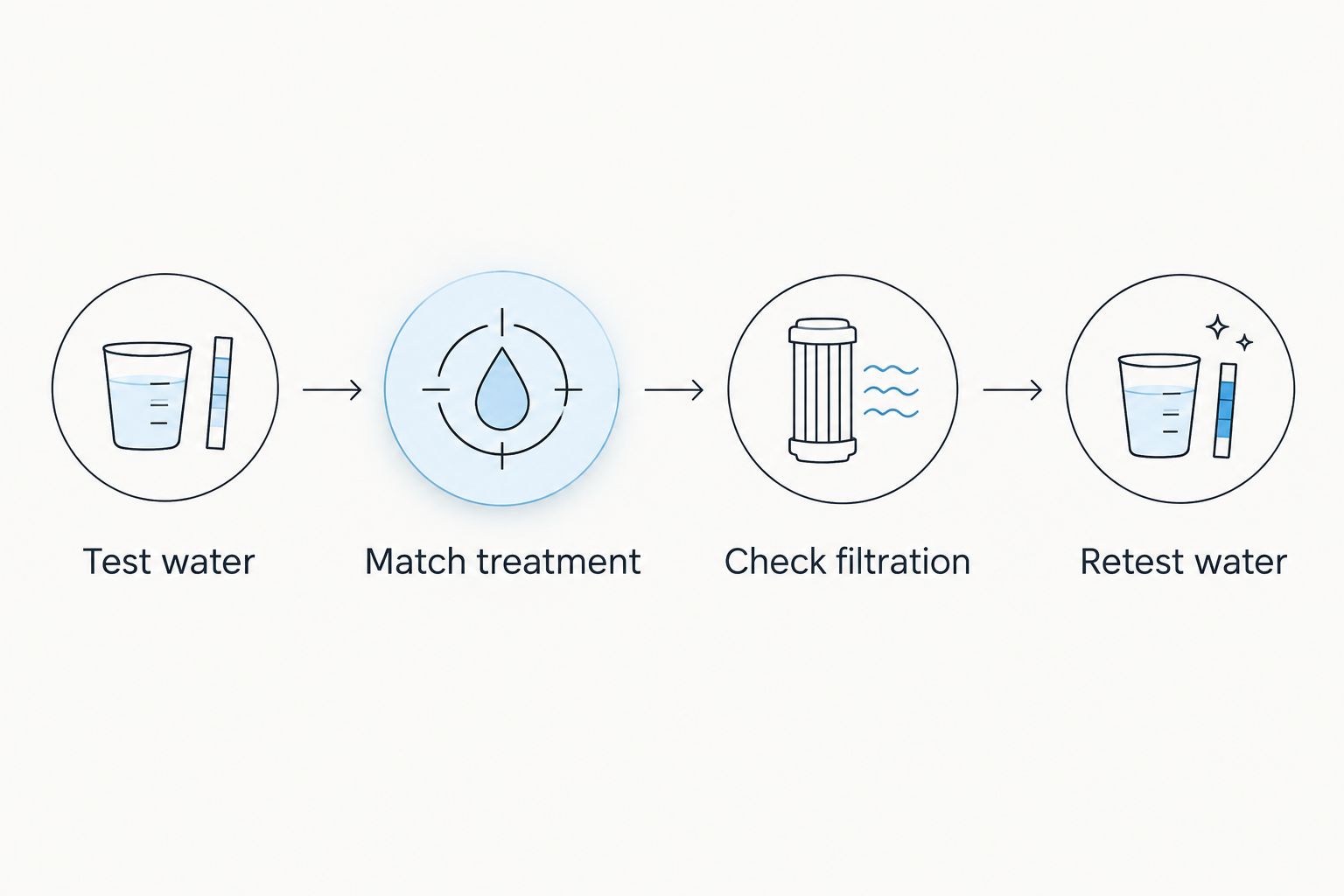
Use this sequence for your 2026 pool-care plan:
- Test water: Record relevant chemistry readings before treatment.
- Match treatment: Choose the chemical that addresses the identified problem.
- Check filtration: Confirm equipment compatibility and the debris-removal route.
- Retest water: Follow label instructions before further treatment or swimming.
The sequence separates chemical selection from dosing. It also prevents you from treating every cloudy pool as a chlorine shortage.
Calculate water volume accurately. A rectangular pool measuring 10 metres long, 5 metres wide and averaging 1.5 metres deep contains 75 cubic metres, or 75,000 litres. Sloping floors require average depth; irregular pools need an appropriate volume calculation.
Never treat that example as a dose recommendation. Product strength and your readings determine the label-based dose. Keep chemicals in their original containers, use the specified protective equipment, and never mix concentrates or reuse contaminated scoops.
How we ranked
This 2026 ranking prioritises treatment fit, identifiable chemistry, equipment compatibility and handling requirements. It is a buying decision tree, not a claim that one chemical outperforms every other chemical at unrelated jobs.
Which pool cleaning chemicals should you choose?
Choose Chloro Maxx TCCA 90 Chlorine Tablets for routine stabilised chlorination when cyanuric acid is controlled. Choose Hypo Pool Shock for rapid oxidation when calcium hardness permits. Add balancing or particle-removal chemicals only when testing and inspection establish the need.
FAQ
What's the best pool cleaning chemical for routine maintenance?
Chloro Maxx TCCA 90 Chlorine Tablets suit routine chlorination when cyanuric acid is monitored. Routine maintenance also requires testing, brushing and filtration.
Is Hypo Pool Shock better than chlorine tablets?
Hypo Pool Shock serves a different treatment role from TCCA tablets. Calcium hypochlorite adds calcium, while TCCA adds cyanuric acid, so your water readings determine the choice.
Can I use a clarifier instead of chlorine?
No, a pool clarifier does not replace chlorine disinfection. Clarifiers help filtration remove suspended particles; disinfectants address microbial contamination.
What's the difference between pool clarifier and flocculant?
A clarifier generally helps the filter capture particles, while a settling flocculant gathers material for removal from the pool floor. Follow the formulation's equipment and removal instructions.
Should I add pH increaser and alkalinity increaser together?
Do not add both automatically. Test pH and total alkalinity, select the required correction, and retest according to the product instructions.
Can I mix pool cleaning chemicals in one bucket?
No, never mix pool chemical concentrates. Incompatible combinations can release toxic gas, generate heat or cause fire; use separate, uncontaminated equipment as directed.
Does clear pool water mean it is safe to swim?
No, appearance does not establish safe disinfectant levels or balanced water. Test the water and observe the treatment label's re-entry requirements before swimming.
One last thing
Clear water is not a chemical test result. For your 2026 maintenance record, keep readings beside each treatment entry: chemical used, label-based dose and retest result. That record is more useful than repeatedly adding the same product whenever the water looks different.
You read this far. Here is 15% off.
Use code POOL15 at checkout for 15% off anything at Zyax.
Shop with POOL15